A five-day educational excursion to Germany included visits to three selected farms engaged in organic agriculture based on the principles of dynamic agroforestry, one of which was an experimental field of the University of Giessen, representing examples of good practice. It was co-financed through the “Organic Trade for Development” program, specifically the project entitled “Sustainable & climate resilient sunflower value chain and corresponding innovative climate resilient production systems”, and organized by the Vojvodina Organic Cluster. Participants in this tour included members of the project from the Institute of Field and Vegetable Crops, Institute of national importance for the Republic of Serbia, the Vojvodina Organic Cluster, company Halba, agricultural producers, representatives of the Research and Development Center LoginEKO, representatives of the Faculty of Agriculture, University of Novi Sad, the Institute for Medicinal Plant Research “Dr Josif Pančić,” Educons University, the Institute for Biological Research “Siniša Stanković,” Institute of national importance for the Republic of Serbia, representatives of Helvetas, as well as other interested supporters of organic agriculture.
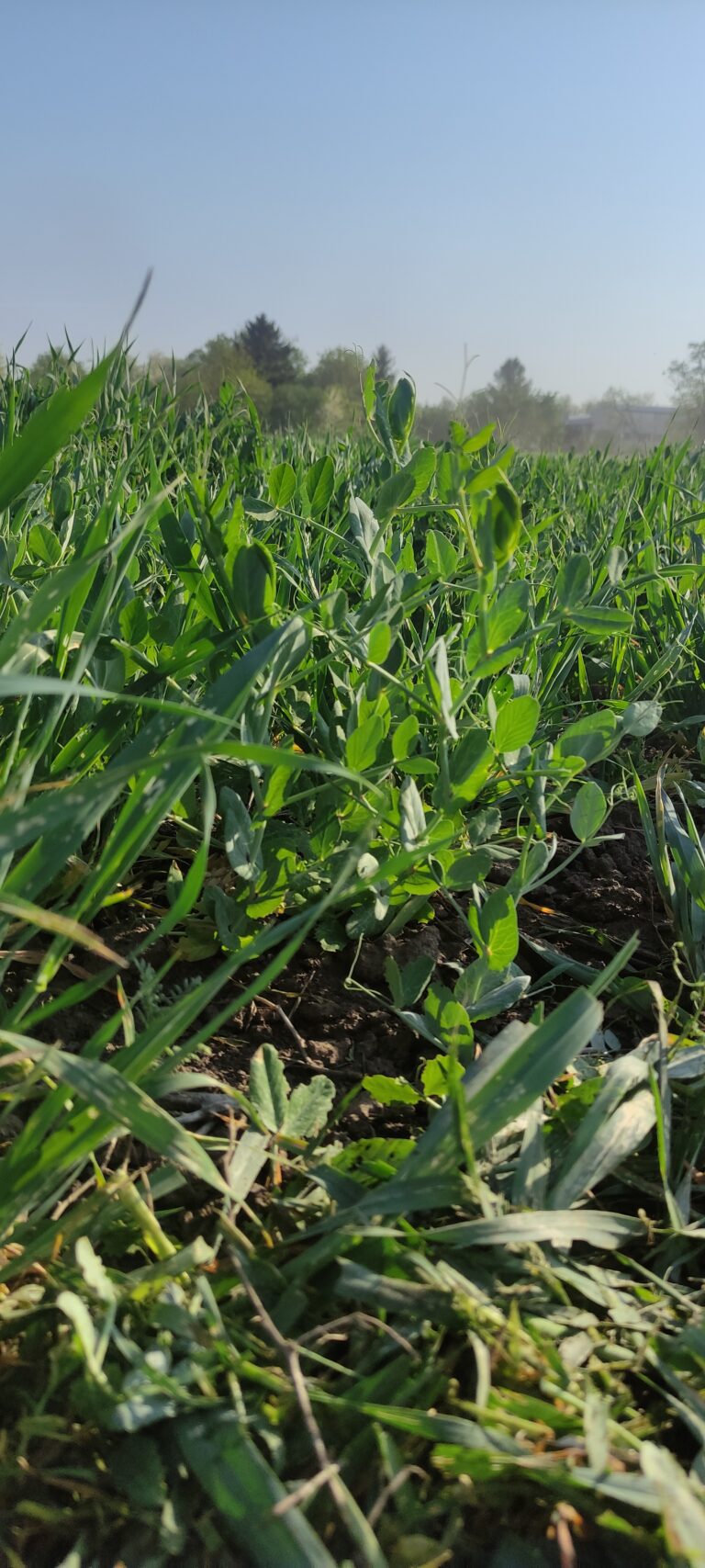
The first farm we visited was Sonnenwald Hof the Center for Regenerative Agriculture. This farm is part of the Sonnenvald community in Schernbach and serves as a research center for regenerative agriculture, focusing on combining sustainable productivity with climate protection, nature conservation, and shared social responsibility. At the start of the visit, Bastian Pellhammer from Ecotop conducted a workshop on the topic of dynamic agroforestry. Afterwards, we shared our experiences from the trials in Serbia with all participants. We then toured the farm’s experimental fields, agroforestry systems established according to the principles of dynamic agroforestry, also known as syntropic farming, as well as the greenhouses and livestock production facilities.


Farm Gladbacher Hof, which serves as both a research center and a self-sustaining farm of Justus Liebig University in Giessen, was our next stop. With its main branches in dairy farming and seed production, this organic farm forms the foundation for teaching and research activities. The core idea of the Gladbacherhof farm is circular economy. Its eight-field crop rotation, in addition to producing seed grains and potatoes, also provides feed for livestock. A portion of the female calves are raised for breeding, while the rest are sold for fattening. The animals supply organic fertilizer for meadows and arable land in the form of manure and slurry. As a teaching and research facility, Gladbacherhof primarily serves to educate and train in organic agriculture. Here, students learn practical farming skills. In addition to optimizing agricultural processes with high humus reserves, one of the main focuses of field research is studying the impact of agriculture on climate. We were presented with the overall operational concept of the farm, after which we toured the experimental fields and various agroforestry systems designed for grazing dairy cows. We also visited the grain processing center and the robotic dairy farm within this facility.


On the last day, we visited the Gut & Bosel Agriculture and Forestry Center, which spans 3,000 hectares and is located east of Berlin. The focus of this center is on land restoration, and it engages in various methods of multifunctional and precision agriculture: from holistic pasture management, composting, syntropic agroforestry, and forest conversion to the development of new software and technology. This farm collaborates with universities and research institutes, working on gathering data and experiences related to multifunctional agriculture, with the aim of making this knowledge accessible to other farmers. During our visit, we saw their agroforestry systems, research composting facilities, as well as crop production based on the principles of intercropping.


During this visit, all participants had the opportunity to gain insights and share their experiences in the field of organic production, as well as advanced practices within it. Producers exchanged contacts with each other, while colleagues from scientific institutions established important connections for future international research collaborations.
At the end of the trip, all attendees visited the city of Dresden, located in the Elbe River valley, about twenty kilometers from the Czech border. Known for its exceptional cultural and historical significance, Dresden is often called the “Florence on the Elbe” (German: Elbflorenz), famous for its Baroque architecture and art collections.