




Scientific Research and Its Impact on Health and the Future of Society
In recent decades, scientific research in various fields has gone far beyond the pursuit of healthier living, prevention, diagnosis, and the improvement of society’s future. Health care is becoming more holistic and encompasses much more than an individual’s mental and physical condition. Although technological solutions are advancing, public health is stagnating. The selection of food and nutrition have become central elements in the vision of human well-being, serving as the foundation for societal, economic, and physical vitality.
Nutrition and Microbiomes: The Key to Disease Prevention
Diet and lifestyle have increasingly become crucial factors in the prevention of various diseases. New research is continually showing how nutrition affects the microbiomes in our bodies, and in turn, these microbiomes influence our health and food preferences. By choosing the foods we consume, we can impact and even reshape these microbiomes. Imbalances in the microbiomes can act as triggers for the development of diseases. This connection is gradually opening up opportunities for science and research to respond and assist in selecting an individual’s diet in order to balance microbiomes and prevent predispositions for disease development.
Teranostics: Innovations for Better Health
By recognizing the complex relationship between our health and the environment, there is an increasing need for accessible and sustainable technologies with easy application. Teranostics, an innovative approach that combines diagnostic and therapeutic functions into a single platform, is leading this advancement. The European Union encourages research and innovation in addressing societal challenges through support for the EINSTEIN project, within the framework of the “Horizon Europe” program (2021-2027), which aims to enhance teranostics based on nutritional food.
Nutritional Sensors
The foundation of nutritional teranostics lies in edible sensors (or food-based sensors), which the EINSTEIN project is based on for their development and application. These sensors will enable precise monitoring of various health parameters, such as temperature, pH levels, the presence of bacteria, and other harmful factors, with the goal of early detection of disease symptoms. As innovative devices, these sensors will be applicable in daily diagnostics, where specific disorders or diseases can be identified non-invasively at an early stage, and then treated through a fully personalized approach to treatment—this being the essence of teranostics.
Application in Medical Disciplines
The application of theranostics extends across a wide range of medical disciplines, including oncology, gastroenterology, and infectious diseases, with increased chances for successful treatment and reduced side effects.
Through the EINSTEIN project, four main factors have come together towards the goal of modern individual health: agriculture, medicine, education, and technology, in order to achieve a complete cycle of development and monitoring of all aspects of edible sensor use—ranging from development and formation using appropriate materials, followed by medical monitoring and usage in diagnostics and treatment, to tracking results and the positive effects of application.
The goal of the EINSTEIN project is to catalyze transformation in rapidly developing countries, such as Serbia, focusing on institutional reforms and promoting sustainable food systems. By integrating medicine, agriculture, technology, and education, the project aims to be a pioneer in theranostics based on sensors and microfluidic chips made from natural materials.
As a professional with years of experience in research and innovation, working on the EINSTEIN project represents an exceptional opportunity to advance in the fields of nutrition and technology. Given the ambition and multidisciplinary approach of the project, I am confident that it will significantly enhance our ability to address the challenges of modern health. The team behind this project brings incredible passion and expertise, which allows us to believe in its long-term sustainability and societal impact. I am certain that the scientific innovations we are developing through EINSTEIN will transform into real solutions that will improve the quality of life.
Nikola Jovanović, Director of Research and Development, Vojvodina ICT Cluster
EINSTEIN will employ a transdisciplinary and multidisciplinary approach to adopt new knowledge and technologies in organic crop production with improved nutritional and bioactive properties (referred to as nutritional crops) for human consumption. These crops will serve as raw materials for the creation of food-based sensors with dual functions: therapeutic and diagnostic.
This initiative for scientific and technological excellence in European innovations has the mission to modernize the educational system in Serbia, bringing it to a leading position in European research and innovation fields. As an example of successful transformation and best practices, the EINSTEIN project can inspire other applications throughout the Western Balkans region.
The long-term goal of the EINSTEIN project is to position the University of Novi Sad among the top 700 universities in the world on the Shanghai ranking by 2030, promoting regional development and social equality through innovation, education, and business growth. By connecting research with practical applications, the project aims to significantly improve societal health.
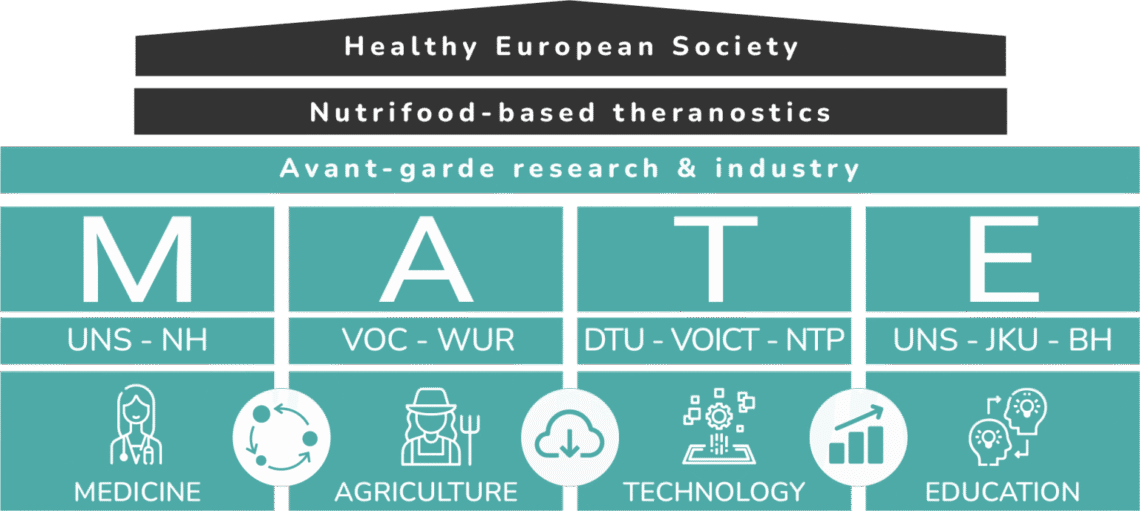
Project partners
EINSTEIN, driven by a vision of accelerated innovation, ecological sustainability, and digital advancement, brings together a consortium of nine partners: four universities, two industry clusters, a science and technology park, a hospital, and a non-governmental organization, hailing from three European Union countries and Serbia as an associated member state.
- Univerzitet u Novom Sadu, Fakultet tehničkih nauka (Novi Sad, Srbija)
- Naučno-tehnološki park Novi Sad (Novi Sad, Srbija)
- Udruženje Biznis na štiklama (Novi Sad, Srbija)
- Vojvođanski IKT klaster (Novi Sad, Srbija)
- NEW Hospital (Novi Sad, Srbija)
- Vojvođanki klaster organske poljoprivrede (Novi Sad, Srbija)
- Johannes Kepler University (Linc, Austrija)
- Wageningen University & Research (Vageningen, Holandija)
- DTU – Technical University of Denmark (Kopenhagen, Danska)
EINSTEIN project leverages the expertise of the Vojvodina Organic Cluster, an association founded by institutions, associations, producers, processors, and distributors of organic products, with the goal of increasing innovation, competitiveness, and sustainability in organic agriculture in Vojvodina. VOC represents over 60 organic producers. The roles of VOC include the creation of the EINSTEIN Agro web platform, which will unify crops rich in micronutrients; the development of promotional leaflets; the creation of recipes targeting citizens focused on nutritionally rich food; the organization of field days for the industry and other interested parties; and the creation of a data management plan.
The focus will be on efforts to remove barriers to innovation, stimulating all ecosystems where there is a willingness to collaborate, in order to bridge the gap between the academic, research, public, and private sectors.
The project began in January 2024 and will last for a full five years, until the end of December 2028. All information about the EINSTEIN project can be found on the official website www.einsteineuproject.com and on social networking platforms X (Twitter), Instagram, YouTube, and LinkedIn.
Contact: social@einsteineuproject.com
Prof. Dr. Goran Stojanović, project coordinator and Dr. Kristina Petrović, project manager
EINSTEIN project is inspired by the exceptional life and contributions of Mileva Marić-Einstein, a prominent Serbian physicist and mathematician. It is significant that she was the only woman among Albert Einstein’s colleagues at the Polytechnic in Zurich and played a key role that has long been insufficiently recognized, often overshadowed by the fame of her husband. The debate over the extent of her influence on Einstein’s revolutionary theories continues, highlighting her significant but often overlooked impact.
Mileva’s involvement in the foundational stages of Einstein’s work is undeniable, especially during their collaboration at the patent office in Bern. Albert Einstein himself acknowledged her influence, saying in 1905: “Everything I have achieved in life, I owe to Mileva. She is my brilliant inspirer, my protector from the hardships of life and science. Without her, my work would never have been started or finished.” This testimony about her role as both an inspiration and collaborator underscores the profound impact that Mileva Marić-Einstein had on one of the most revolutionary scientific minds of the 20th century, and serves as a guiding vision for the goals and aspirations of the EINSTEIN project.


